
The Neufeldt lab develops new catalytic methods that can streamline the synthesis of organic compounds or transform simple molecules into value-added products. In particular, our research centers around the use of molecular transition metal catalysts whose properties can be tuned by their ligand environment. We value mechanistic insight as a critical tool for rational catalyst design. For this reason, our research approach integrates experimental and computational techniques.
Controlling Selectivity in Catalysis
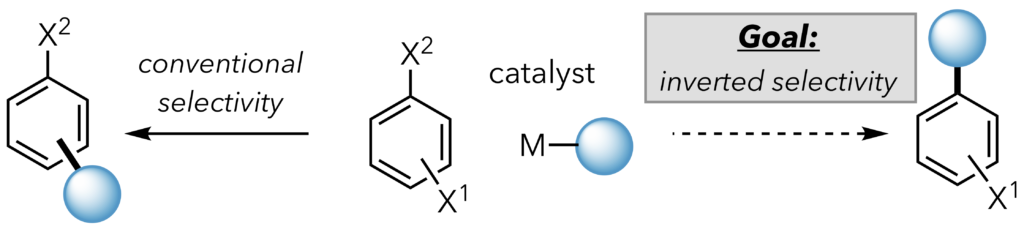
One area of research focuses on controlling selectivity in cross coupling reactions. For example, we are studying the ways that ligands, Pd speciation, and novel cross-coupling mechanisms influence palladium’s preference for reaction at different positions of electrophiles. Our goal is to develop catalytic systems for cross coupling that can provide unconventional selectivity, thereby improving the versatility of cross-coupling in organic synthesis.
Understanding Reaction Mechanisms
Mechanistic understanding provides a foundation for developing new reactions. Much of our work focuses on understanding mechanistic details, both related to cross-coupling reactions as well as other transition metal-catalyzed and organic transformations. In addition to using DFT, we use heavy atom kinetic isotope effects and other more traditional kinetic techniques.